
Sustainable Economic Growth
ETG Economics • Eugene Toh
ETG Economics • Free JC / H2 Economics Notes (Singapore)
Economic Growth (and Unemployment): the “Must-Know” Frameworks
If you’re revising H2 / JC Economics, this page compresses the core ideas into “gold-only” notes: actual vs potential growth, sustained vs sustainable growth, plus the 3 types of unemployment and the policy logic behind AD management.
- Best for: JC1–JC2 / H2 Econs
- Diagrams: AD-AS + PPC
- Exam focus: definitions + chain-of-reasoning
- Context: Singapore + real-world examples
Economic growth — the clean definition
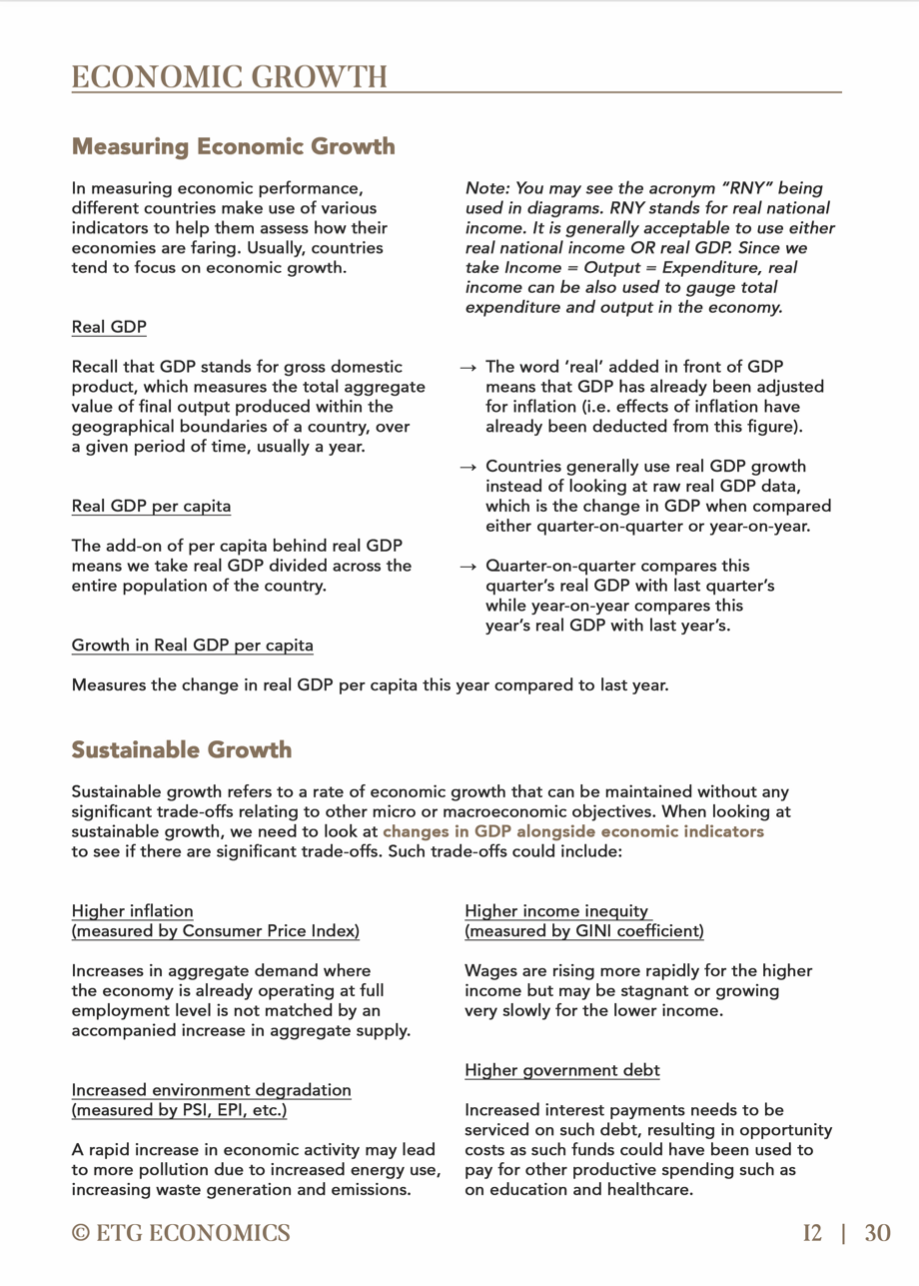
Economic growth = an increase in a country’s real GDP (often discussed as GDP per capita growth).
In plain English: the economy produces a higher value of goods & services than before.
Why governments like growth
- Higher incomes → higher living standards (more options, not just “more stuff”).
- Higher tax revenue → more ability to fund education, healthcare, infrastructure.
The “but…” (growth isn’t free)
- Growth driven by “work more hours” can trade off against leisure and wellbeing.
- Growth can come with inflation, environmental strain, or inequality (depending on the growth model).
Actual vs Potential growth (AD-AS + PPC)
1) Actual economic growth
Actual growth happens when real output rises (real GDP increases). It commonly comes from higher aggregate demand (AD) that pushes firms to produce more using existing capacity.
- AD-AS: a rightward shift of AD increases Y (real national income) until you hit full employment output.
- PPC: moving from a point inside the PPC towards the PPC boundary = resources are used more fully → output rises.
2) Potential economic growth
Potential growth = an increase in the economy’s productive capacity (the maximum output it can produce at full employment).
- AD-AS: rightward shift of the LRAS (full-employment output rises from YF₀ → YF₁).
- PPC: the entire PPC shifts outward (the economy can produce more of both goods).
- Drivers: productivity gains (tech/AI), education & training, capital investment, larger labour force.
The exam trap: Potential output can rise even if actual output doesn’t.
If AD doesn’t keep up, the output gap widens → more unemployment pressure.
Sustained vs Sustainable growth (don’t mix them up)
Sustained growth
Sustained growth means growth continues year after year (not boom–recession–boom).
- If you only push AD, you eventually hit full employment → inflation rises, output stops rising.
- If you only push AS / capacity but AD is weak → output gap expands → unemployment rises.
So the “sustained” recipe: grow AD and AS together.
Sustainable growth
Sustainable growth = growth achieved with minimal long-run damage (especially environmental degradation and unsustainable public debt burdens).
- Environment: growth that ignores pollution/resource depletion creates long-run costs.
- Debt: stimulus via borrowing can shift problems to future taxpayers via interest payments.
A tight way to write it in essays:
“Sustained” = consistency over time.
“Sustainable” = growth without unacceptable long-run trade-offs (e.g., environment/debt).
Unemployment: definition + 3 types
You are unemployed only if you meet all 3 criteria:
(1) able to work, (2) actively seeking work, (3) cannot find work.
1) Cyclical unemployment
Caused by the business cycle. In a downturn, AD falls → output falls → firms hire fewer workers → unemployment rises.
- Think: recession shock (e.g., COVID demand collapse).
- Diagram logic: AD shifts left → Y falls below YF → output gap grows.
2) Structural unemployment
A skills mismatch: workers’ skills don’t match the jobs available. Often driven by technology, changing industries, or trade shifts.
- Classic idea: some roles become obsolete; new roles require different skills.
- Fix usually needs training/retraining (supply-side).
3) Frictional unemployment
The “in-between” unemployment due to imperfect information and search time: firms don’t instantly know the best worker, and workers don’t instantly find the best job.
- Often temporary → usually the least worrying type.
- Policies improve matching (job portals, placement support, better labour market info).
Policies: what they’re “trying to do” (in one page)
Demand management policies
Main target: raise AD (especially for cyclical unemployment / weak growth).
- Expansionary monetary policy: increase money supply → lower interest rates → C and I rise → AD rises.
- Expansionary fiscal policy: increase G and/or cut taxes → C and/or I rise → AD rises.
Supply-side policies
Main target: raise productive capacity and improve efficiency/skills.
- Training & upskilling → productivity rises → costs fall → competitiveness improves.
- Retraining helps reduce structural unemployment (skills mismatch).
- Better matching systems help reduce frictional unemployment.
Why growth + unemployment are often taught together:
policies that raise AD can raise output and reduce cyclical unemployment at the same time.
Lesson videos (watch + revise fast)
Economic Growth & Unemployment
ETG ECONcepts
Inclusive Growth (Singapore)
ETG Economics • Eugene Toh
Textbook visuals (for diagram + definition anchoring)
Want help turning these frameworks into exam marks?
If you’re looking for economics tuition in Singapore that is ruthlessly focused on results, ETG Economics specialises in A Level (H1/H2) and IB Economics only. Our lessons don’t just “teach content” — we drill the exact definition → diagram → chain-of-reasoning style that examiners reward.
You’ll also get the practical stuff that makes improvement predictable: exclusive learning materials, weekly graded homework, and personalised consults to fix weak topics early. Prefer onsite or online? ETG supports both — including blended flexibility when life gets chaotic.
If you want to see how ETG runs (and whether it fits you), the fastest move is simple: book a trial and come experience one lesson properly — not a “sales pitch”, a real class.
FAQ (quick, high-yield)
What’s the difference between actual and potential economic growth?
Actual growth is when real output (real GDP) rises — typically because AD rises and firms produce more using existing capacity. Potential growth is when the economy’s capacity increases — shown by LRAS shifting right or the PPC shifting outward.
Why can chasing AD-only growth become a problem?
Once the economy is near full employment output, further AD increases can push up prices more than output. Growth slows, but inflation pressure rises.
Why is cyclical unemployment linked to AD-AS?
In downturns, AD falls and equilibrium output drops below full employment output (YF). The output gap reflects resources (including labour) that are idle — i.e., higher unemployment.
What policies reduce structural unemployment?
Structural unemployment is a skills mismatch. Supply-side policies like retraining, reskilling, and education subsidies help workers transition into industries where jobs exist.